
The Ship That Won the War: US Liberty-class Cargo Vessel
The Liberty ship is one of the most important vessels in naval history - not for her firepower, but for her sheer numbers and strategic impact. Between 1941 and 1945, American shipyards produced 2,710 Liberty ships, delivering the men, machines, and supplies that sustained Allied operations across every theater of World War II. Built to a simple, standardized design derived from British tramp steamers, Liberty ships could be assembled in as little as four days using prefabricated sections — a revolutionary approach to wartime production.
At 1/96 scale, the Liberty ship presents a rewarding and historically significant build. Her clean, functional lines, distinctive three-island layout, and wealth of deck detail make her an ideal subject for both display and diorama work.
Ship Overview
The Liberty ship (EC2-S-C1 type) measured 441 feet (134.4m) overall, with a beam of 57 feet (17.4m) and a loaded displacement of approximately 14,245 tons. Powered by a single triple-expansion steam engine producing 2,500 shaft horsepower, she could make 11 knots - slow by wartime standards, but reliable and economical. Her five cargo holds could carry over 9,000 tons of war materiel. Armament varied by period and theater, but typically included a 4-inch or 5-inch gun aft, a 3-inch gun forward, and multiple 20mm Oerlikon AA guns.
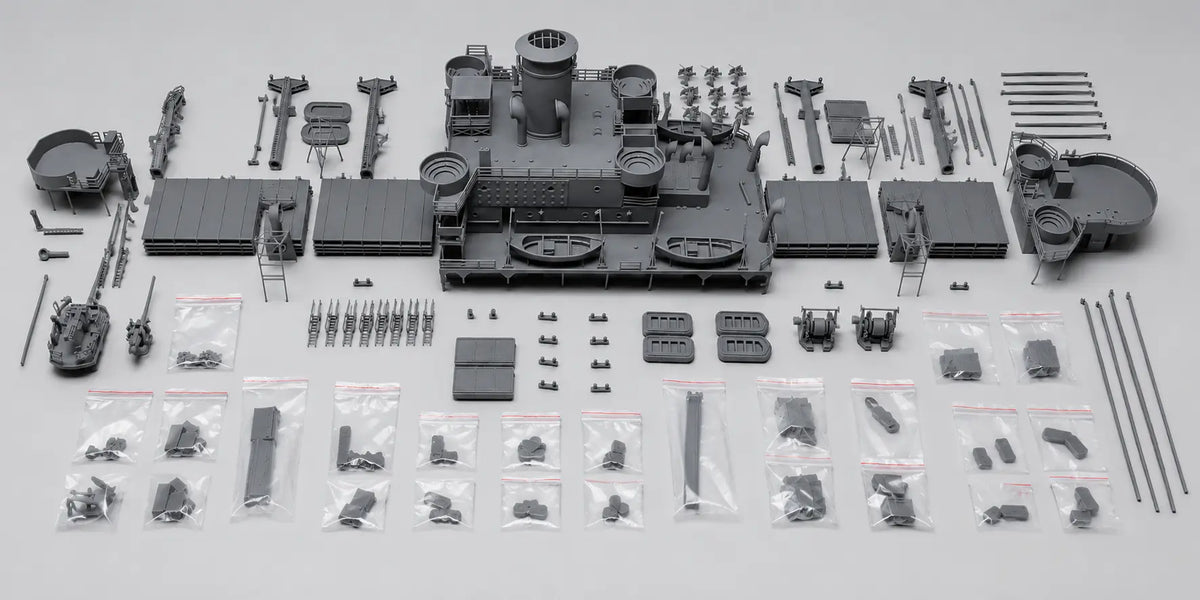
Detail Sets - Complete Parts List
All components below are 3D-printed from primary source references and period photographs to ensure historical accuracy. Each part is delivered clean and ready to prime.


Hull & Decks


Cargo Hatches


Masts & Mast Houses


Funnel

Bridge & Wheelhouse


Upper Deck Fittings


Lifesaving Equipment


Armament Platforms


Painting Guide
Liberty ships wore a variety of camouflage schemes throughout the war. The most common include:
- Measure 21 - Navy Blue overall, used in the early war period and in Pacific waters.
- Measure 22 - Navy Blue hull with Haze Gray topsides; the most widely applied mid-war scheme.
- Measure 32 - Multi-color dazzle camouflage, applied to some vessels from 1943 onward.
- Merchant Gray - A plain medium gray overall, common on vessels in less contested waters.
Decks were typically painted in a non-slip dark gray or left as bare steel. Cargo booms and masts were often in a lighter gray or buff. Cross-reference your chosen scheme against period photographs for the specific vessel and year you are modeling.
Build Tips
- Build and paint the three island structures (forecastle, midship house, poop deck) as separate sub-assemblies before joining to the hull - access for painting is much easier.
- The five cargo hatches are a defining visual feature; take care with alignment and ensure they sit flush on the deck.
- Rig the cargo booms and mast stays last, using EZ Line or stretched sprue for a scale appearance.
- The 20mm Oerlikon gun tubs on the bridge wings and gun platforms are small but visually prominent — paint and install these before adding railings.
- A waterline diorama with a loaded, low-riding hull evokes the wartime convoy atmosphere perfectly.
Reference Sources
- Naval History and Heritage Command (NHHC) photo archive - nhhc.navy.mil
- MaritimeQuest - maritimequest.com (extensive Liberty ship photography)
- Liberty Ships: The Ugly Ducklings of World War II - John Gorley Bunker
- SS Jeremiah O'Brien (preserved Liberty ship, San Francisco) — official documentation and photographs
Have questions about your build? Contact us - we're always happy to help. Share your finished build with us on social media!

Leave a comment
This site is protected by hCaptcha and the hCaptcha Privacy Policy and Terms of Service apply.