
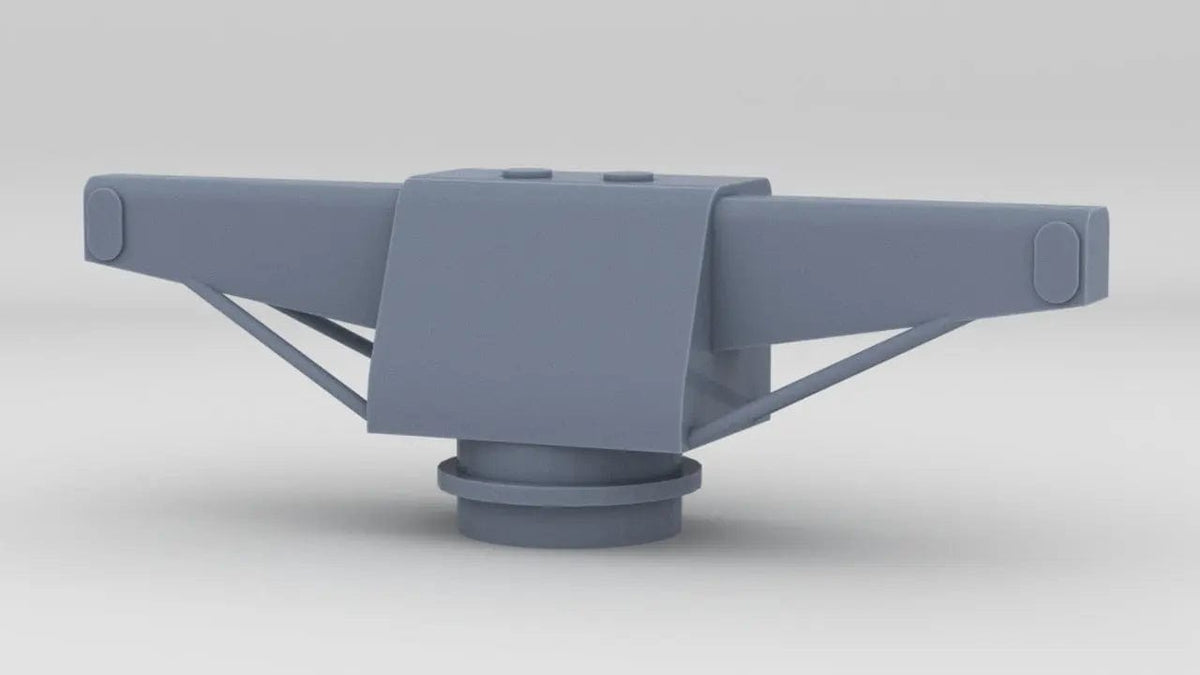
1/200 USS Arizona BB39 Forward Rangefinder
Our 3D-printed parts are designed using original historical drawings and specifications. Dimensions may differ from commercially available model kits, even when advertised in the same scale.
Using a kit from another manufacturer? After placing your order, please Contact Us with your order number and the exact dimensions of your existing model parts before production begins so we can verify compatibility.
Compatibility with third-party kits cannot be guaranteed without prior dimensional verification.
1/200 USS Arizona BB-39 Forward Bridge Rangefinder: Dreadnought Fire Control Optics Fidelity
Bring an exceptional layer of technical density, structural authority, and naval combat realism to the crowning tier of your forward bridge tower with the masterfully engineered 1/200 Scale USS Arizona BB-39 Forward Bridge Rangefinder. Mounted prominently atop the armored conning tower and navigating bridge deckhouse of the Pennsylvania-class battleship USS Arizona (BB-39), this critical optical instrument served as the primary range-taking installation for the forward command group and navigational plot during her service with the Pacific Fleet, right up to that fateful morning at Pearl Harbor on December 7, 1941. Elevated immediately below the forward tripod fighting top, this specialized long-base stereoscopic rangefinder allowed gunnery officers and navigation spotters to calculate precise target ranges and bearings across open ocean horizons with pinpoint optical triangulation. Scaled precisely to standard 1/200 builder scale, this dedicated standalone optical upgrade captures the elongated cylindrical optical tube, armored end-objective prism hoods, central operator housing, rotating azimuth foundation ring, and deck mounting plate of original Bureau of Ordnance (BuOrd) and Bureau of Ships (BuShips) builder plans with flawless fidelity.
Engineering Precision and Forward Bridge Deck Optics Fidelity
At 1/200 scale, the forward bridge roof is the primary structural apex directly overlooking the forward super-firing 14"/45 gun turrets, making the rangefinder installation an unavoidable high-contrast focal point exposed to close visual scrutiny. This replica forward rangefinder captures the purposeful, muscular profile of pre-war American naval fire control equipment with surgical clarity, eliminating the thick, out-of-round plastic tubes, molded-over end prisms, soft cast seams, and alignment warping typical of factory injection-molded kit parts. Deployed atop the pilothouse or forward director platform of your 1/200 scale build, the assembly features true-to-scale physical relief, creating realistic physical shadow lines and deep mechanical contrast that basic kit placeholders cannot match.
- Museum-Quality Arsenal Replication: Developed using original technical layouts, historical U.S. Navy Bureau of Ordnance blueprints, and archival Pearl Harbor photographic surveys to accurately reproduce the exact physical dimensions, optical tube taper, end prism geometry, and foundation turntable proportions of the forward bridge installation on the USS Arizona (BB-39).
- Prototypical 1/200 Capital Ship Scope: Specifically engineered for large-format 1/200 scale battleship models (including the Trumpeter USS Arizona BB-39 kit and related Pennsylvania-class builds), custom scratch-built forward superstructure conversions, and museum-grade maritime diorama displays.
- Bridge-Top Crown Position: Sized and contoured specifically to occupy the high-visibility forward position atop the bridge levels, capturing the distinctive armored protective housing and support pedestal.
- Exposed Hardware & Optical Detail: Authentically captures the transverse optical bar, angled end-objective hood visors, central observer eyepiece station, training and tracking gear access panels, periscope sight blisters, and circular azimuth mounting ring with raised fastener bolt impressions.
- True-to-Scale Volumetric Depth: Replicates the true physical three-dimensional presence of heavy naval optical hardware, casting realistic deep shadows beneath the transverse tube overhang, within the recessed objective apertures, and around the circular mounting base against surrounding deck non-skid plate.
- Streamlined Bridge Integration: Engineered with a precision-molded flat base contact pad designed to seat cleanly, squarely, and securely flush onto standard 1/200 scale bridge roof decks or dedicated rangefinder pedestals, drastically reducing assembly friction and streamlining installation.
- Intelligent Material Optimization: Expertly designed in High Detail Resin Grey with an optimized structural profile to manage material mass while preserving maximum rigidity, ensuring a crisp, warp-free assembly with a dead-straight horizontal optical tube that will not sag, droop, or distort over time.
Premium Material: High Detail Resin Grey
To satisfy the absolute highest demands of micro-detailed static presentation across delicate scale fire control gear and specialized naval optical instruments, this forward bridge rangefinder is crafted exclusively from premium High Detail Resin Grey.
- Exceptional Feature Definition: This premier formula achieves surgical multi-dimensional precision and an ultra-smooth, non-porous surface finish, capturing the finest mechanical facets—from razor-sharp prism hood visors to miniature access hatch seams and deck flange bolt heads—with absolute sharpness and zero layer line distraction.
- Professional Foundation: Provides an ultra-smooth base specifically optimized for high-quality marine primers, fine-scale technical pin-washes, micro-masking, and authentic pre-war and early-war US Navy camouflage finishes, ensuring flawless paint adherence.
- Superior Quality: Manufactured by distefan 3d print, ensuring clean surfaces, straight optical concentricity, and outstanding dimensional integrity for a luxurious, professional-grade finish.
Key Features and Specifications
- Accurate 1/200 Scale Precision: Precision-engineered for seamless, historically proportional integration with standard 1/200 scale capital ship kits, scratch-built bridge towers, and museum-grade static displays.
- Historically Authentic Fleet Hardware: Faithfully represents the physical configuration of the standardized forward bridge-top optical rangefinder operated aboard the USS Arizona (BB-39) during her 1941 Pearl Harbor operational configuration.
- Single-Piece Centerpiece Integration: Engineered as a unified, high-integrity unit for straightforward alignment, eliminating the fragile multi-joint gluing of separate tube halves.
- Hollowed Lightweight Design: Features an optimized internal cavity that minimizes top-heavy weight atop tall bridge assemblies while maintaining maximum structural stiffness across the wide-span optical crossbar.
- Unpainted Finish: Arrives completely unpainted, providing an open canvas for custom finishing. Customize the assembly to reflect standard U.S. Navy Measure 1 (light gray upper works), wartime Measure 21 (overall 5-N Navy Blue), or pre-war No. 5 Standard Navy Gray finishes.
- The Definitive Bridge-Top Optics Overhaul: Replaces simplified, solid-molded plastic placeholders with a sophisticated, historically correct three-dimensional representation of vital naval optical calculation hardware.
A Canvas for Battle-Tested Fleet Artistry
Arriving in its raw finish, the 1/200 USS Arizona BB39 Forward Rangefinder serves as the ultimate starting point for advanced multi-layer painting, precise component color-blocking, and realistic maritime weathering.
- The Battleship Row Scheme: Base-coat the cylindrical optical tube, operator housing, and mounting pedestal in authentic period-correct vertical camouflage colors—such as pre-war Light Gray (5-L) or early-war 5-H Haze Gray matching BB-39's forward superstructure in late 1941. Paint the interior faces of the end objective prism hoods in matte black, detailing the recessed glass lenses in gloss black with jewel-clear gloss drops to simulate optical glass. Pick out the operator eyepiece fittings, training gear access covers, and azimuth scale ring in dark gunmetal, burnished steel, or oily graphite to emphasize operational mechanical separation against surrounding structure.
- Realistic Frontline Operational Weathering: High-altitude bridge optics thrive on rich washes, textural filters, and environmental staining. Apply rich dark raw umber and soot black oil washes into the end prism visor recesses, around the operator access hatches, and along the deck mounting flange seam to establish deep structural shadows. Add realistic weathering effects like bare-metal chipping along the access handles and base rim where bridge watch standers worked, dried white salt spray mineral crusting layered heavily across the forward-facing windward surfaces from charging through Pacific trade-wind swells, and vertical rust streaks weeping downward from baseplate mounting pads toward bridge deck scuppers to capture the true look of a veteran dreadnought maintaining vigilant watch over the fleet.
This product has no reviews yet.